
How a Shared Instructional Vision Can Strengthen Assessment System Coherence


Collaborative work on that vision is key
It’s no secret that many of us at the Center for Assessment are obsessed with balanced assessment systems. The original idea, outlined in Knowing What Students Know: The Science and Design of Educational Assessment, seemed so straightforward, but it has been tough to put into practice. We have been working with district leaders on a key principle of balanced systems—coherence—and we think we have some helpful ideas to share.
Anyone who has worked on balanced assessment knows where the challenges lie: Constraints due to federal law, and the need for significant structural and cultural shifts in schools and districts. As we discussed in Implementing Balanced Assessment Systems: A Practical Guidebook for Districts & Schools, operationalizing coherence has proved especially difficult.
Coherence was one of the three criteria articulated by the authors of Knowing What Students Know. Coherence requires, among other things, that the various assessments in the system are linked to a common model of learning (cognition), but this has been challenging to implement.
Implementing coherence requires a solid understanding of modern theories of human learning and development, but many assessment developers and users lack this background. It has also been challenging because researchers and theorists have not operationally defined coherence in ways that give practitioners a clear vision of what they need to design and implement.
Coherence: The Word of the Year
Coherence seems to be everywhere right now. Education First’s “Rethinking the Test Pile” identified several core problems, one of which was misalignment (or lack of coherence) among teaching, learning, and high-quality instructional materials in the schools that they studied.
Coherence is also featured in TNTP’s “Opportunity Makers” as one of the key features of “gap closing” districts. They noted that “[t]rajectory-changing schools ensure that all pieces of the school’s instructional program—curriculum, materials, interventions, and assessments—work together to advance the same set of grade-level expectations.
Anchoring Coherence in an Instructional Vision
One approach to examining coherence among teaching, learning, instructional materials, and assessment, in light of how students learn and develop, is through a collaboratively developed instructional vision, which is a statement that describes the overall purpose of learning and what teaching and learning should look like in a particular content area. We set out to do just that with district leaders from a large southern school district. Over the course of a day and a half, we created discipline-specific instructional visions. We also created a more overarching statement that could be shared with parents or other constituents, for whom the disciplinary nuances are less salient.
Rather than presenting the district leaders with a blank page and asking them to start writing, we began with an exercise in which we shared two distinct flavors of instructional visions for English/language arts (ELA).
Unknown to the participants, one statement deliberately emphasized discrete skills and memorization. This statement aligns more with behaviorist principles, in which content is broken into small steps and learning and behavioral changes are produced through reinforcement and repeated practice.
The other statement summarized key components of sociocultural learning theory, which positions learning as fundamentally mediated by social interaction, language, and culture. We asked participants to discuss these two ELA visions in small groups and to identify which one better represented their view of how teaching and learning should be in their district. A paired example is below.
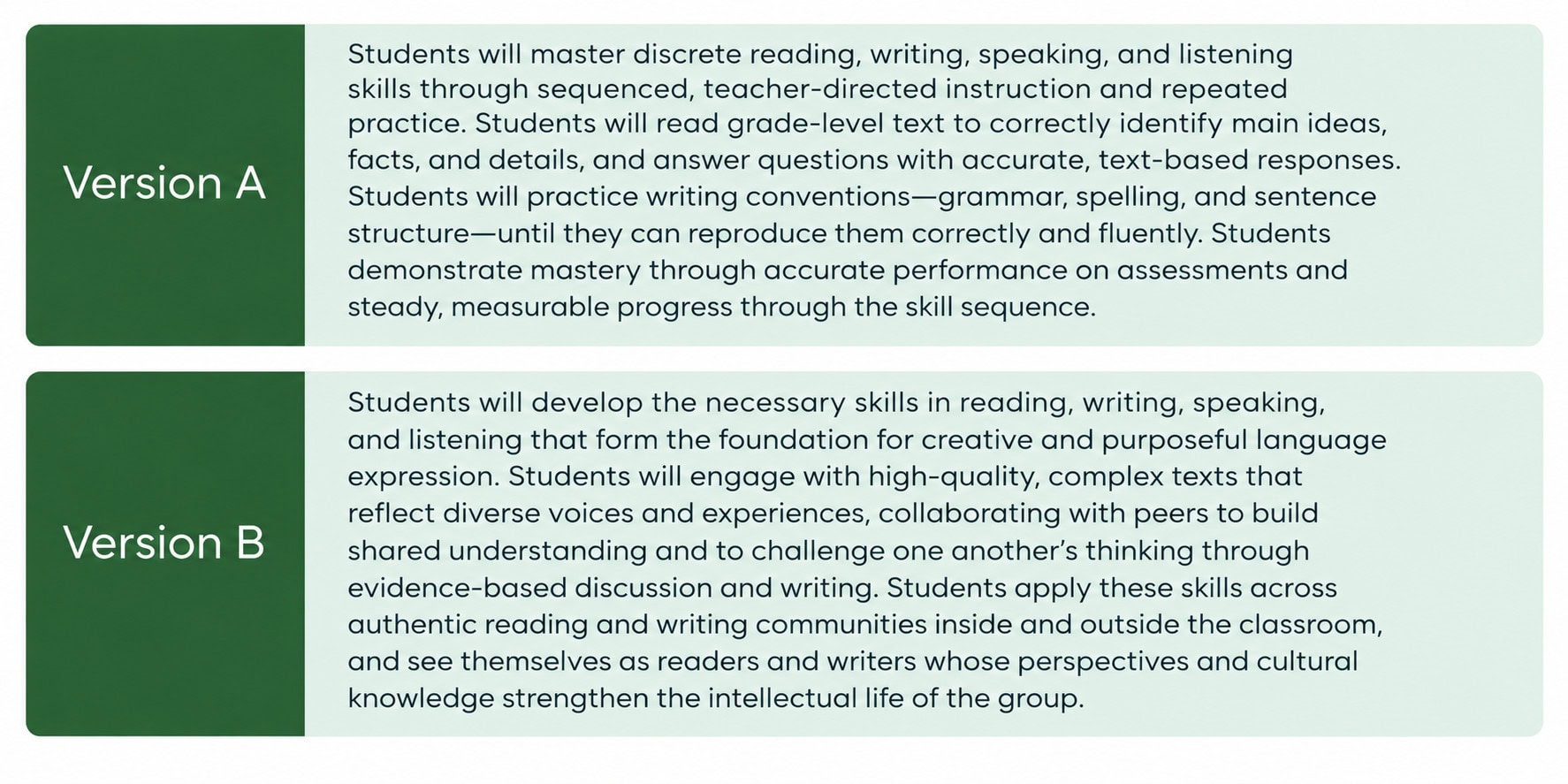
Each group independently selected the vision statement that was more aligned with sociocultural learning (Version B). They valued providing students with opportunities to engage in grade-level-appropriate, challenging learning in collaboration with peers. We acknowledge that groups may have converged on the sociocultural statement due to shared values about learning, or simply chose the paragraph that sounded more current and appealing. We are not arguing for these particular statements. We suggest that getting leaders to respond to something concrete surfaces more than asking them to describe their beliefs abstractly.
The groups (district assessment and curriculum leaders) then worked together on their own disciplinary instructional visions, drawing on other district resources to inform their work. Groups swapped drafts for feedback, shared it with the whole group, and had a chance to revisit their statements the following day after further reflection.
An instructional vision should not be included in a set of departmental resources only to be ignored afterward. Rather, it should be a tool for coherence and provoke additional questions, such as:
- What would a student experience be like in a classroom aligned with this instructional vision?
- In what ways do the instructional materials align with these visions of teaching and learning?
- How do teachers, particularly novice teachers, get support in terms of understanding and enacting these visions?
- In what ways do the suite of assessments (both internal and externally mandated) support these visions?
- What would a principal or department chair expect to see or not see in a classroom aligned with this instructional vision?
Learning theories are typically not part of the day-to-day discussions of school and district leaders. However, asking colleagues to articulate the kinds of practices and thinking they want to see from students can help spark such discussions. Honing these descriptions into an instructional vision can then serve as a touchstone for the kinds of questions listed above, and help a district make incremental moves towards greater coherence.
(For additional support, Implementing Balanced Assessment Systems: A Practical Guidebook for Districts and Schools has two appendices: one focused on creating an instructional vision and one on applying that vision to examine the coherence of an assessment system.)
Taking the Next Steps Toward Coherence
Now that district curriculum and assessment leaders have coalesced around common, content-specific instructional visions, we will use these visions as touchstones in an assessment audit . An assessment audit asks key constituents to review all assessments administered in schools and classrooms and recommend which should be retained and which eliminated.
Participants must consider the evidence supporting the intended uses for each assessment. However, to create a balanced system, they also need to anchor these decisions on a common model of learning so that students and teachers do not get mixed signals about how learning should progress and be demonstrated. We think shared instructional visions can aid this effort.