
Don’t Start With Assessment: Navigating State Involvement in 21st Century Competencies

Moving From Support to Accountability
State policymakers across the country are increasingly interested in how 21st century competencies (21CCs)—such as critical thinking, collaboration, creativity, and self-direction—can be elevated within K-12 systems. These transferable skills are highly valued by employers and essential for preparing students for success beyond high school. Policymakers often suggest assessing these skills, both to gauge how well schools and districts are doing in imparting them and to incentivize them to focus on these skills.
However, assessment is not a neutral act, especially when tied to high-stakes decisions like accountability ratings or funding. There are many considerations—often underestimated—related to the tradeoffs of state involvement in this space. Before jumping into large-scale testing, we need to step back and ask a fundamental question:
Why would we assess these things if we aren’t teaching them explicitly?
Assessment is not the place to start.
Watch a video of Carla’s webinar presentation on assessing 21st century competencies or review her slides. Both are from a webinar by the National Association of State Boards of Education’s High School Transformation State Network community of practice. The Center’s collection of blogs and literature reviews on this topic are in our toolkit, Assessing 21st Century Skills.
The Challenges of Measuring 21st Century Competencies
The measurement challenges associated with assessing 21st century competencies are significant and well-documented. As described in the Assessing 21st Century Skills toolkit developed by the Center for Assessment, these challenges include:
- Clear definitions and claims: States must first define what they want to measure and why. Vague constructs like critical thinking often overlap with related skills like problem-solving and creativity, creating definitional confusion (jingle-jangle fallacies).
- Reliable scoring: Most 21st century competencies require performance-based tasks, portfolios, demonstrations of learning, capstone projects or observations, rather than multiple-choice questions. These richer demonstrations of learning are resource-intensive to design, implement, and score reliably.
- Domain mapping: Gathering enough evidence to support a general claim—such as “this student is an effective collaborator”—is difficult because these skills are deeply embedded in specific content and contexts.
- Learning progressions: Unlike in traditional academic subjects, we lack validated developmental pathways that describe how competencies such as collaboration or self-regulation evolve from early grades through high school.
These complexities mean that no single test can capture a student’s proficiency in 21st century competencies in a valid and comprehensive way. For a deeper exploration of these issues, see the full state and district guidance paper included in the toolkit.
A Continuum of State Involvement
Given these challenges, what role should states play? States have different options to signal their policy values related to 21st century competencies. Some involve state-level assessment, while others do not. Understanding these options helps policymakers make intentional choices that align with their vision and capacity. These are just some examples along a continuum:
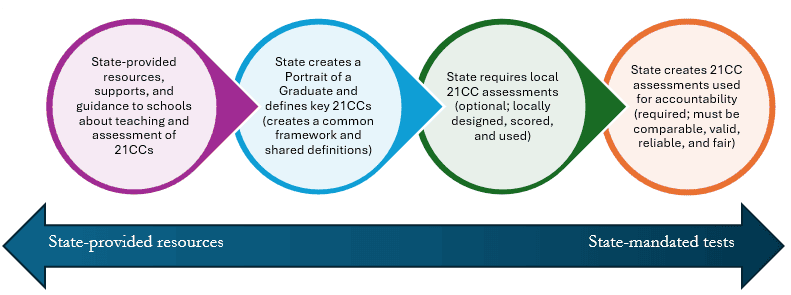
At one end of the continuum, states can create and mandate statewide assessments in 21st century competencies that can be used for accountability. This approach requires assessments to be comparable, valid, reliable and fair, like traditional state tests. While this sends a strong policy signal, it also raises the highest risk of unintended consequences, such as narrowing instruction or incentivizing superficial compliance.
Moving along the continuum, states might require local assessments in these skills, but allow districts to design and score them. In this model, states focus on setting expectations while providing flexibility for local adaptation.
Further toward the supportive end, states can develop a Portrait of a Graduate to define shared goals and articulate what 21st century competencies mean within their context. This creates a common framework without prescribing specific assessments.
Finally, states can simply provide resources, guidance, and professional learning to help schools integrate 21st century competencies into teaching and learning. This approach emphasizes capacity-building rather than measurement.
The key takeaway: states have choices. They do not have to leap immediately to high-stakes assessment to make progress. Even modest actions, like defining a Portrait of a Graduate or offering teacher resources, can signal that these competencies matter.
Recommended First Steps
Before deciding where to position themselves on the continuum, states should work through three foundational questions:
- What problem are we trying to solve?
- Clarify your state’s vision for 21st century competencies.
- Identify why these skills matter and what outcomes you hope to achieve.
- Determine where assessment fits into this vision. Is the goal to improve instruction, evaluate program effectiveness, or hold schools accountable?
- What are our constraints and requirements?
- Consider practical factors such as total testing time, cost, as well as local and state capacity.
- Be clear about the required uses of assessment results and the limitations of available resources.
- What would success look like?
- Establish clear criteria for success to guide design and implementation. For example, success might mean increased teacher confidence in teaching collaboration or better data to support student self-reflection.
By thoughtfully addressing these questions, states can avoid rushing into solutions that overpromise and underdeliver, or lead to unintended negative consequences.
Moving Forward With Intentionality
The allure of measuring 21st century competencies at scale is understandable. These skills are vital for student success and future workforce readiness. But assessment should not drive the work—it should support it. States must resist the temptation to start with testing, especially when instructional systems for teaching these skills are not yet fully developed.
State leaders have multiple entry points for action. Whether by defining a Portrait of a Graduate, investing in teacher professional development, or exploring pilot projects, they can advance this important work without immediately raising the stakes.
As we consider the continuum of involvement, let’s keep sight of the ultimate goal: equipping all students with the competencies they need to thrive in a rapidly changing world. Thoughtful, measured action today will lay the groundwork for sustainable progress tomorrow.
Photo by Allison Shelley/The Verbatim Agency for EDUimages